by Mike | Jun 9, 2026 | Business Owners |
Introduction
Automation has become one of the most powerful features in modern marketing.
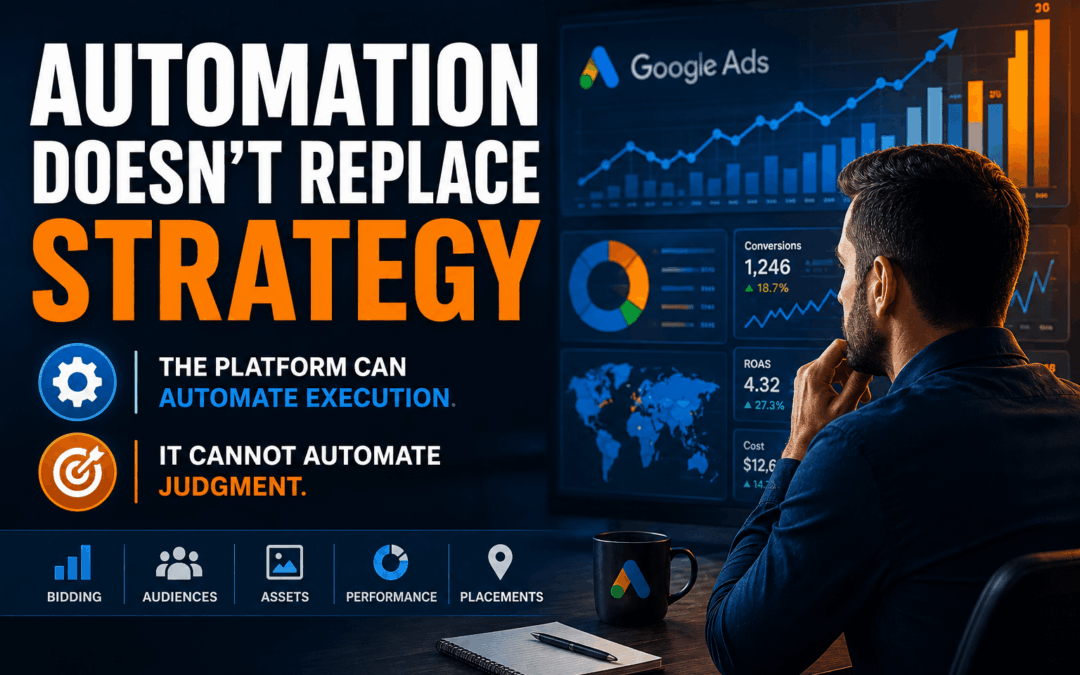
Google Ads automation can help manage bidding, placements, budgets, audiences, creative assets, and attribution. But automation is only as useful as the strategy behind it.
The reason is simple:
Automation executes the strategy. It does not create a strategy.
The Promise of Automation
Many advertisers approach automation with the expectation that it will solve their marketing challenges.
The thinking often goes something like this:
“If Google has enough data and enough artificial intelligence, it should know how to find my customers.”
Unfortunately, that’s not how marketing works.
Automation can only optimize toward the goals and signals it receives.
If those goals are poorly defined, the system becomes extremely efficient at pursuing the wrong outcome.
Faster Isn’t Always Better
Imagine entering the wrong destination into a GPS.
The navigation system may be incredibly sophisticated.
It may calculate traffic patterns, road closures, and the fastest route available.
But none of that matters if the destination is wrong.
Google Ads automation works much the same way.
A powerful system moving in the wrong direction simply gets you there faster.
Why Businesses Get Into Trouble
Many businesses make decisions based on short-term pressure.
One challenge with automation is that it cannot assess the quality of a business decision.
If a target changes, automation will pursue the new target.
If a budget changes, automation will adapt to the new budget.
The system can execute decisions efficiently, but it does not determine whether those decisions support the broader goals of the business.
Automation cannot distinguish between the two.
It simply follows instructions.
The Real Competitive Advantage
The businesses that consistently outperform competitors are not necessarily the businesses with the best automation.
They are the businesses that make better decisions.
They understand:
- Their goals
- Their margins
- Their customers
- Their competitive position
- Their acceptable level of risk
Because they understand these factors, automation has good information to work with.
Final Thoughts
Google Ads automation can help advertisers manage bidding, budgets, audiences, creative assets, and other campaign settings.
However, automation still operates within the goals, constraints, and information provided by the advertiser.
When performance improves, it can be difficult to separate the contribution of automation from the decisions that shaped the campaign strategy.
For that reason, many advertisers continue to focus on business goals, measurement, and decision-making alongside automated tools.
Automation may change how campaigns are managed, but it does not eliminate the need for strategic thinking.
Automation can execute a strategy.
Determining what that strategy should be remains a business decision.
Google Ads can provide data.
The challenge is deciding what matters.
If you’re looking for a place to discuss strategy, challenge assumptions, and make better marketing decisions alongside other business owners, join the Catalyst early signup list.
Join the Early Signup
by Mike | May 28, 2026 | Google Ads |
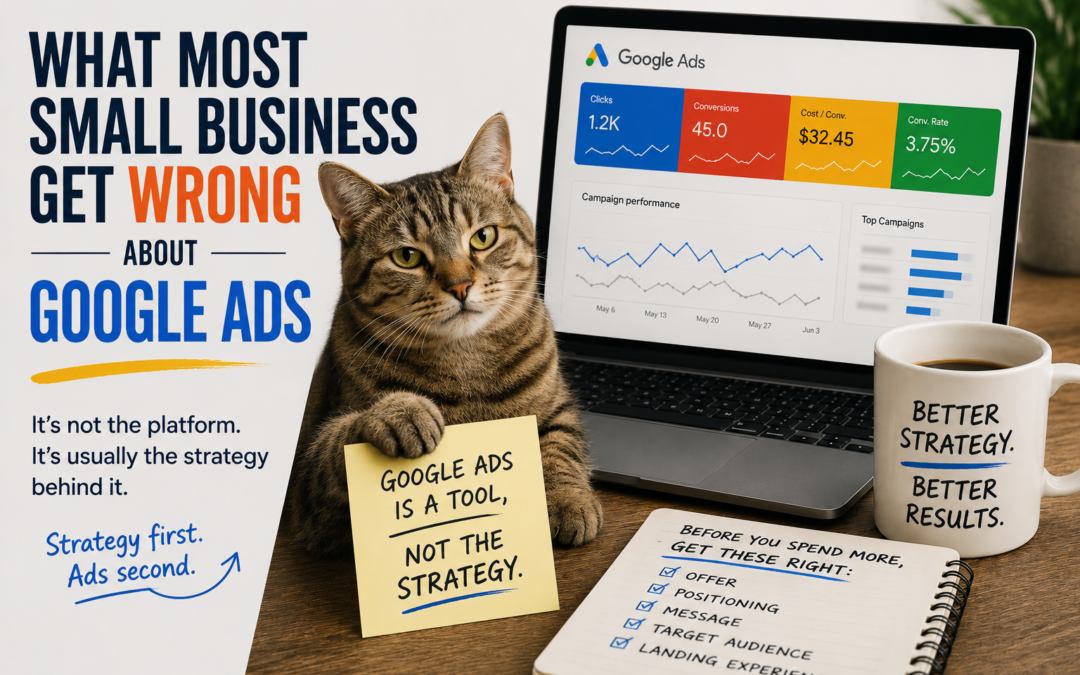
Most small businesses think Google Ads is the strategy.
It’s not.
Google Ads is a tool.
A powerful tool, but still a tool.
When results disappoint, many business owners assume the platform is broken.
So they change agencies.
Change campaigns.
Change budgets.
Change settings.
But rarely do they stop and ask a harder question:
Is the strategy clear?
Google Ads can’t fix a weak offer.
It can’t create demand for something people don’t want.
Google Ads can help reveal a positioning problem.
It can show which messages get attention.
It can show which offers attract clicks.
It can show which landing pages are not converting.
But it does not automatically create a clear position for the business.
And if the business looks too similar to every competitor, Google Ads may expose that problem faster than it solves it.
The businesses that get the most from Google Ads understand something important:
The platform doesn’t create a competitive advantage.
It amplifies one.
The first question isn’t whether Google Ads is working.
The first question is whether the business has given Google Ads a strategy worth amplifying.
The question is whether the business has given Google Ads something worth amplifying.
Want More Strategic Thinking About Google Ads?
Most Google Ads advice focuses on campaigns, settings, and tactics.
Catalyst focuses on something more valuable: helping business owners make better decisions before they spend more money.
Join the early signup list and discover a different way to think about Google Ads, Performance Max, and business growth.
by Mike | May 21, 2026 | Google Ads |
When performance drops, most advertisers feel pressure to act.
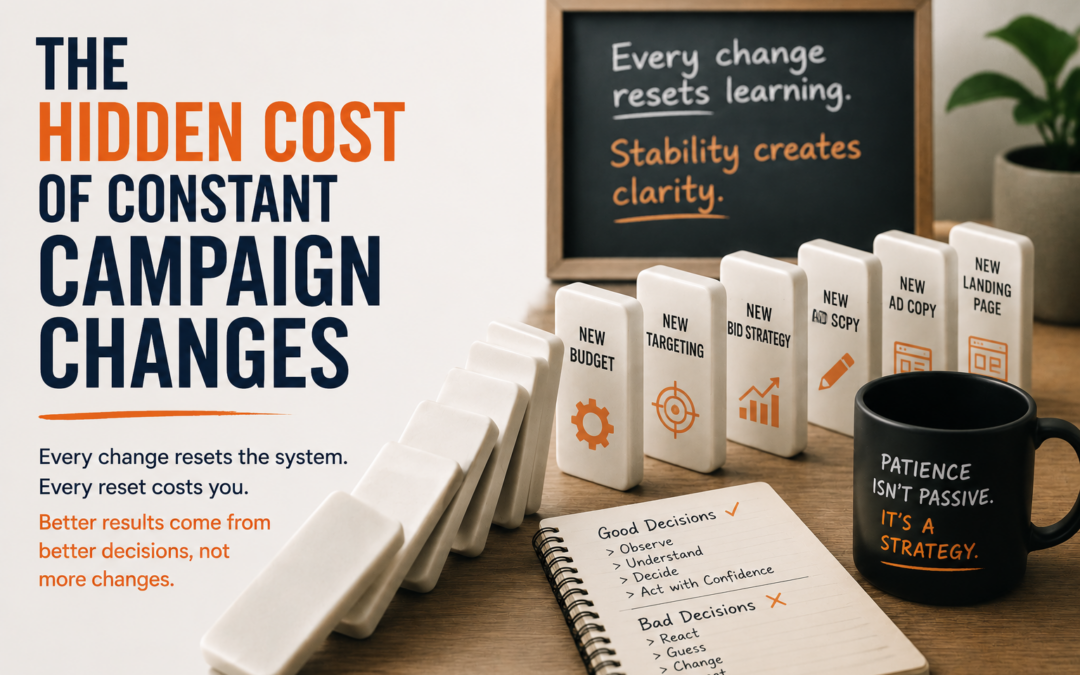
Change the budget.
Change the targeting.
Change the bidding strategy.
Change something.
Anything.
The problem is that activity feels productive even when it isn’t.
Every change sends a signal into the system.
Every adjustment creates new variables.
Every reaction makes it harder to know what actually caused the result.
Sometimes the biggest threat to performance isn’t the campaign.
It’s the person managing it.
The best advertisers understand that not every dip requires a response.
Not every fluctuation requires a fix.
And not every uncomfortable moment requires action.
Patience isn’t the absence of strategy.
Sometimes it is the strategy.
The goal isn’t to make more changes.
The goal is to make better decisions.
Want More Strategic Thinking About Google Ads?
Most Google Ads advice focuses on what to change next.
Catalyst focuses on knowing when not to.
Join the early signup list and learn how growth-focused businesses make smarter advertising decisions, avoid unnecessary changes, and think strategically about Google Ads and Performance Max.
by Mike | May 14, 2026 | Google Ads |
Advertisers love data.
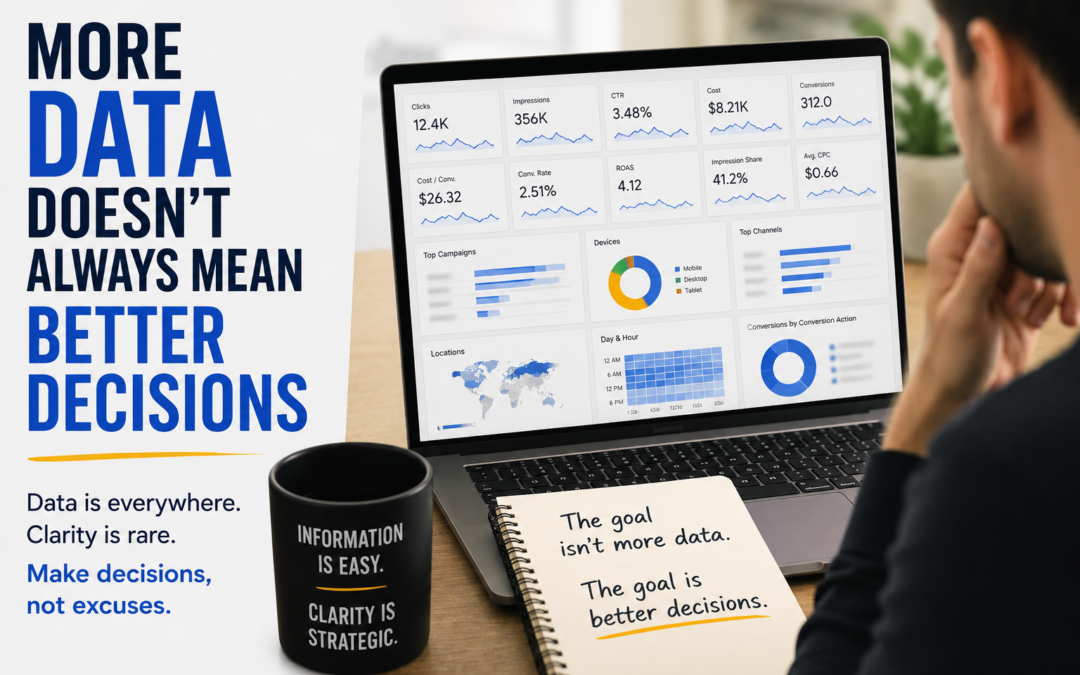
More reports.
More dashboards.
More metrics.
More attribution models.
More insights.
But here’s the problem:
The goal isn’t to collect information.
The goal is to make decisions.
A pilot doesn’t fly an airplane by staring at every gauge in the cockpit.
A pilot knows which gauges matter right now.
The same is true in Google Ads.
Many businesses are drowning in data while starving for clarity.
They know their click-through rate.
They know their cost per click.
They know their impression share.
Yet they still don’t know whether they’re making better business decisions.
Data is valuable.
But only when it helps answer an important question.
Otherwise, it’s just noise wearing a spreadsheet.
The businesses that grow aren’t the ones with the most data.
They’re the ones who know which data matters.
Want More Strategic Thinking About Google Ads?
Most Google Ads advice focuses on metrics, reports, and platform features.
Catalyst is built for business owners who want something different: clearer thinking, better decisions, and fewer expensive mistakes.
Join the early signup list and discover a smarter way to think about Google Ads and Performance Max.
by Mike | May 7, 2026 | Google Ads |
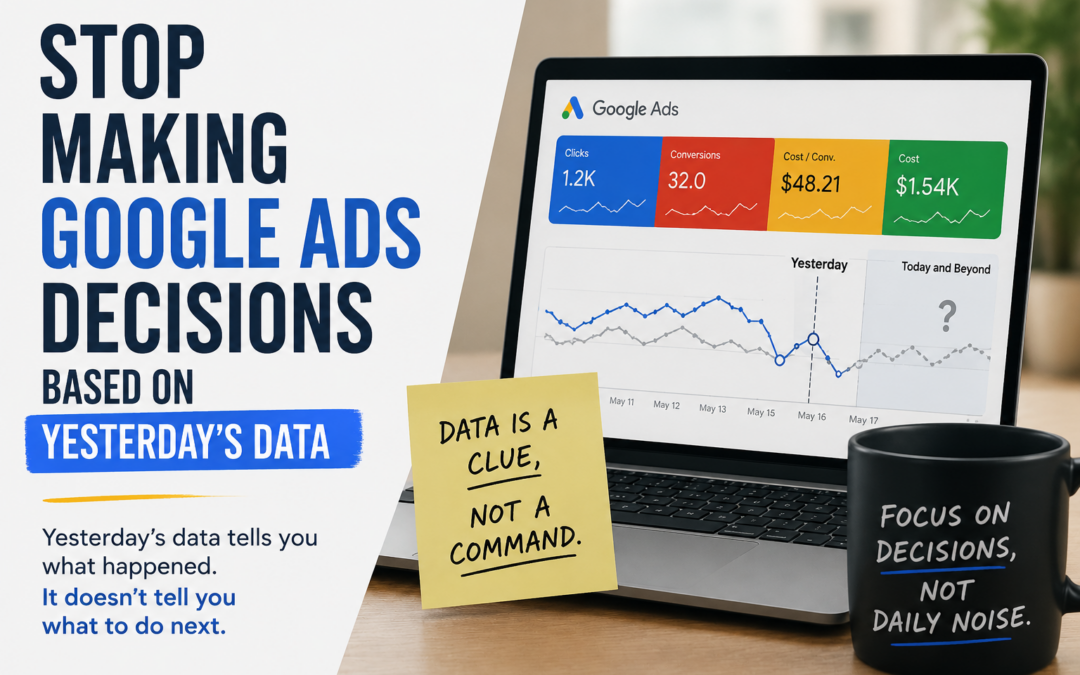
Yesterday’s data tells you what happened.
It doesn’t tell you what’s happening.
And it certainly doesn’t tell you what’s about to happen.
Yet every day, advertisers log into Google Ads, see a metric move, and immediately react.
Conversions drop for two days?
Change the campaign.
Cost per lead increases?
Change the budget.
ROAS dips?
Change the bidding strategy.
But what if the data isn’t the problem?
What if the market changed?
What if demand shifted?
What if customers are simply behaving differently this week than they did last week?
Data is a clue.
It’s not a command.
The best advertisers don’t react to every number they see. They use data to ask better questions.
Because the goal isn’t to manage reports.
The goal is to make better decisions.
Want More Strategic Thinking About Google Ads?
Most Google Ads advice tells you what buttons to click.
Catalyst is built for business owners who want to think more clearly, make better decisions, and avoid expensive mistakes before they happen.
Join the early signup list and discover a different way to think about Google Ads and Performance Max.
by Mike | Apr 30, 2026 | PMax |
Most advertisers think Performance Max is a campaign type.
That’s because Google put it in the Campaigns menu.
But that’s like saying Amazon is a warehouse.
You’re describing what it is, not what it does.
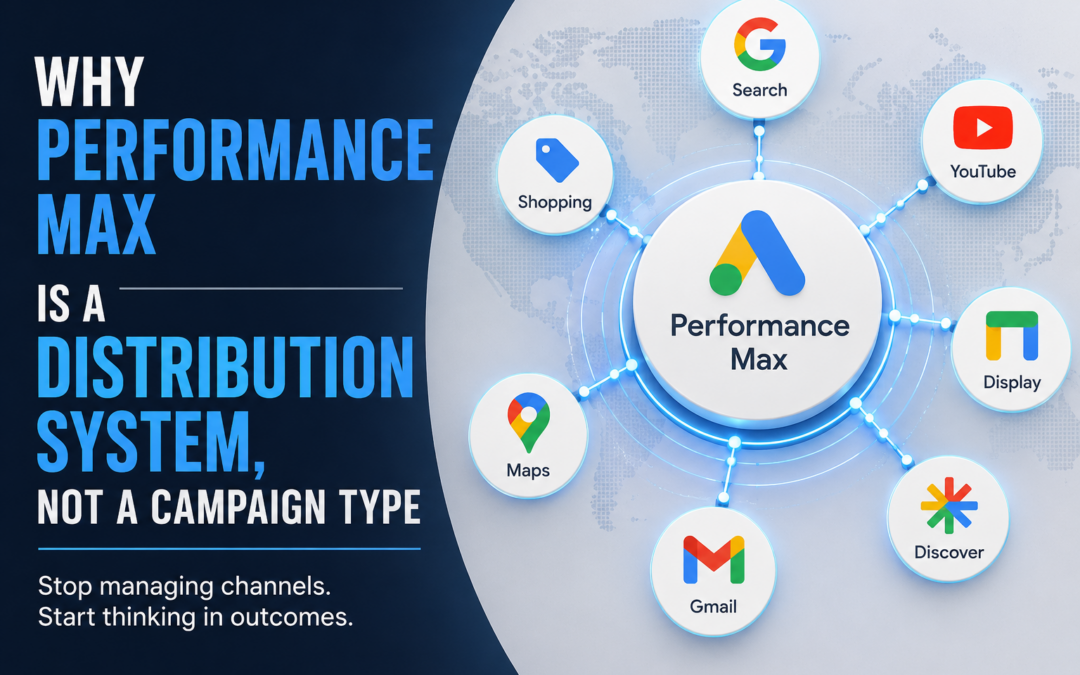
Performance Max doesn’t behave like Search, Display, or Shopping. It distributes your message across Google’s ecosystem and decides where the opportunity is most likely to exist.
That’s not a campaign.
That’s a distribution system.
The mistake many businesses make is spending their time trying to manage the distribution.
The smarter question is whether the message being distributed is worth seeing.
A weak offer distributed perfectly is still a weak offer.
A confused strategy distributed at scale only creates confusion faster.
Performance Max isn’t the strategy.
It’s the vehicle.
The businesses that win aren’t obsessed with where Google showed the ad.
They’re obsessed with whether the business gave Google something worth distributing.
That’s the difference between managing campaigns and thinking strategically.
Want More Strategic Thinking About Google Ads?
Most Google Ads advice focuses on tactics.
Catalyst focuses on helping business owners make better advertising decisions before costly mistakes occur.
Join the early signup list and get insights designed to help you think more clearly about Google Ads, Performance Max, and business growth.