

Introduction
Automation has become one of the most powerful features in modern marketing.
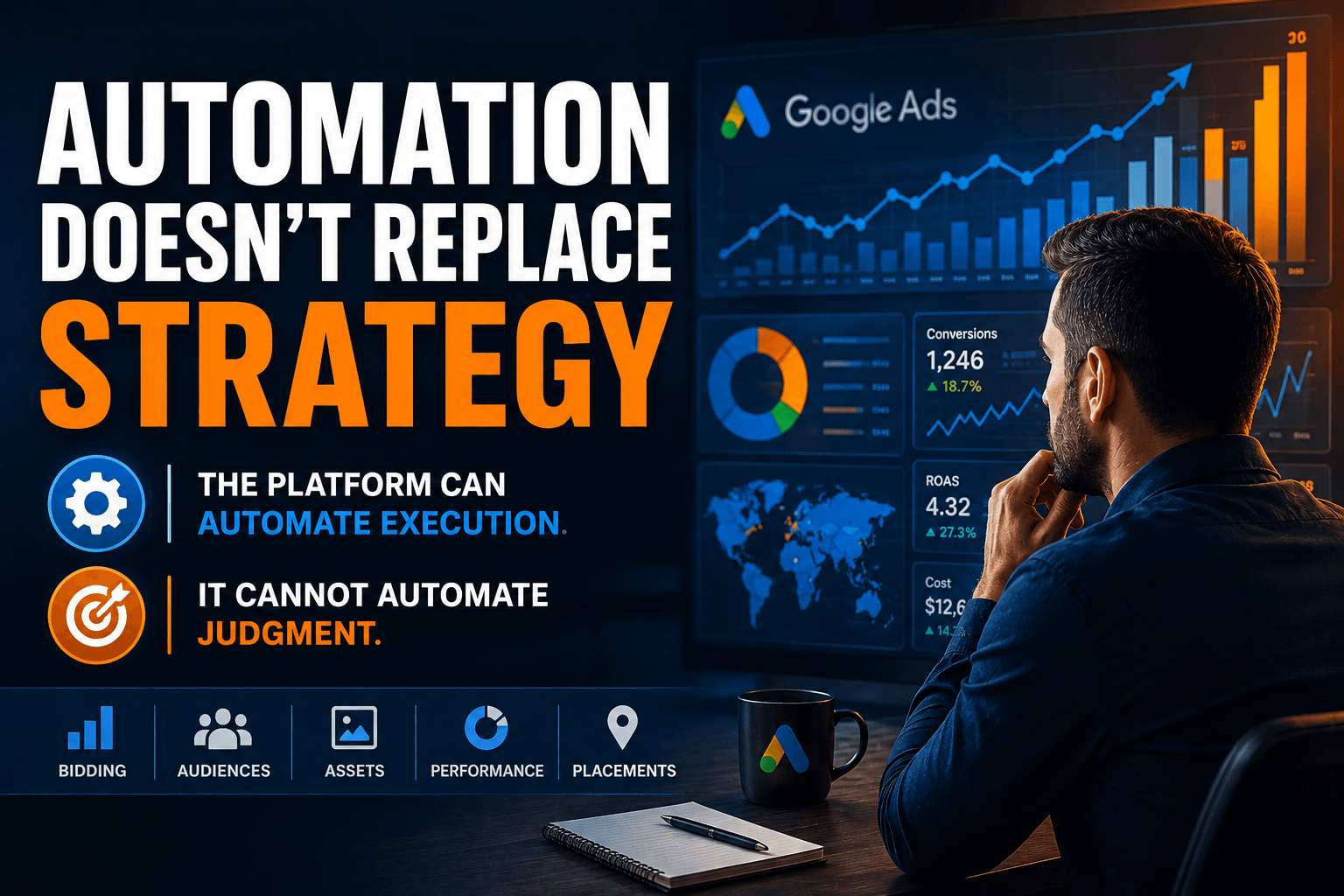
Google Ads automation can help manage bidding, placements, budgets, audiences, creative assets, and attribution. But automation is only as useful as the strategy behind it.
The reason is simple:
Automation executes the strategy. It does not create a strategy.
The Promise of Automation
Many advertisers approach automation with the expectation that it will solve their marketing challenges.
The thinking often goes something like this:
“If Google has enough data and enough artificial intelligence, it should know how to find my customers.”
Unfortunately, that’s not how marketing works.
Automation can only optimize toward the goals and signals it receives.
If those goals are poorly defined, the system becomes extremely efficient at pursuing the wrong outcome.
Faster Isn’t Always Better
Imagine entering the wrong destination into a GPS.
The navigation system may be incredibly sophisticated.
It may calculate traffic patterns, road closures, and the fastest route available.
But none of that matters if the destination is wrong.
Google Ads automation works much the same way.
A powerful system moving in the wrong direction simply gets you there faster.
Why Businesses Get Into Trouble
Many businesses make decisions based on short-term pressure.
One challenge with automation is that it cannot assess the quality of a business decision.
If a target changes, automation will pursue the new target.
If a budget changes, automation will adapt to the new budget.
The system can execute decisions efficiently, but it does not determine whether those decisions support the broader goals of the business.
Automation cannot distinguish between the two.
It simply follows instructions.
The Real Competitive Advantage
The businesses that consistently outperform competitors are not necessarily the businesses with the best automation.
They are the businesses that make better decisions.
They understand:
- Their goals
- Their margins
- Their customers
- Their competitive position
- Their acceptable level of risk
Because they understand these factors, automation has good information to work with.
Final Thoughts
Google Ads automation can help advertisers manage bidding, budgets, audiences, creative assets, and other campaign settings.
However, automation still operates within the goals, constraints, and information provided by the advertiser.
When performance improves, it can be difficult to separate the contribution of automation from the decisions that shaped the campaign strategy.
For that reason, many advertisers continue to focus on business goals, measurement, and decision-making alongside automated tools.
Automation may change how campaigns are managed, but it does not eliminate the need for strategic thinking.
Automation can execute a strategy.
Determining what that strategy should be remains a business decision.
Google Ads can provide data.
The challenge is deciding what matters.
If you’re looking for a place to discuss strategy, challenge assumptions, and make better marketing decisions alongside other business owners, join the Catalyst early signup list.
0 Comments